The Vietnamese economy is on the verge of a historic transformation. According to Mr. Dang Van Thanh, Chairman of TTC Group, 2026 is not merely a milestone in the development roadmap, but a crucial foundational year, opening a "new race track" for the 2026-2030 cycle.
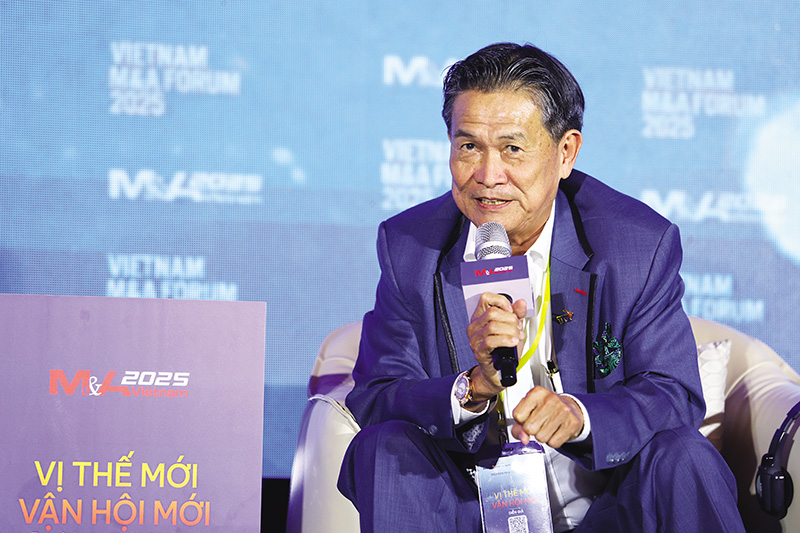 Chairman of TTC Group, Dang Van Thanh, is confident in the economic outlook for 2026.
Shifting the focus from "stimulating supply" to "stimulating demand"
The Chairman of TTC believes that 2025 will be the time to summarize the 2021-2025 strategy, creating momentum for 2026 to become a "pivotal year" of a new development cycle. With strong shifts from macroeconomic policies to corporate governance thinking, this is seen as the time for Vietnam to break through, aiming for ambitious yet feasible growth targets.
In the context of a still volatile global economy, Vietnam enters 2026 with enthusiasm and an increasingly compatible policy foundation. This businessman even sees this as potentially the beginning of a 50-year development cycle.
“Looking back at the past 10-15 years, economic change has always followed the strict laws of progress and elimination. On this new path, macroeconomic factors such as exchange rates, inflation, and interest rates remain the most discussed ‘three key issues,’ but they are no longer a major concern if businesses know how to assess them to plan strategies and organize their operations,” said the Chairman of TTC.
Regarding economic growth prospects, Mr. Dang Van Thanh optimistically believes that GDP in 2026 could reach 8% to 10%, or even 10% if the fundamental conditions are strengthened. This figure reflects confidence in the inherent strength of the economy as policy barriers are gradually removed.
One of the core messages emphasized by Mr. Thanh is the need to change the mindset of policy management, shifting from focusing on supporting the “supply” side to strongly activating the “demand” side. According to him, after the Covid-19 pandemic, many of Vietnam's policies mainly focused on stimulating supply, such as tax reductions, interest rate cuts, and debt extensions. However, these measures only impacted the "supply side." Meanwhile, to achieve sustainable growth and double-digit GDP targets, the economy needs a boost on the "demand side" to stimulate purchasing power and strengthen consumer confidence.
The Chairman of TTC also put forward a groundbreaking proposal: reducing personal income tax, but in the form of vouchers instead of cash. For example, if a person has to pay 10 dong in tax and receives a 30% reduction, instead of letting them keep 3 dong in cash, the State will issue a timed voucher worth 3 dong for consumption. The difference lies in the fact that timed vouchers will force money to flow directly into the circulation of goods, stimulate retail sales, and increase the "circulation" of money in the real economy.
“Once consumption increases, businesses generate revenue, production resumes, and the budget gains new revenue, creating a healthy and self-reliant cycle,” the Chairman of TTC said, emphasizing that with a market of over 100 million people, Vietnam can be completely proactive, instead of being overly dependent on exports.
“Simply put, the economy is like a vehicle that needs both engines working in sync. If policies supporting manufacturing businesses are the ‘fuel’ (supply), then measures to stimulate consumer spending are the ‘combustion engine’ (demand). Only when both operate together can the growth vehicle accelerate rapidly and sustainably on the new race track,” the head of TTC Group explained from practical experience.
Public investment leads the way, the private sector is key.
Regarding the pillars of growth in 2026, public investment is projected to continue to be a crucial driving force, especially in the South – where major infrastructure projects such as the Ring Road 3, the Ho Chi Minh City - Moc Bai Expressway, and the Bien Hoa - Vung Tau Expressway are transforming the region into a massive construction site. However, Mr. Thanh noted that public investment is only a temporary, short-term driving force.
The long-term and substantial driving force of the economy must come from the private sector. The Politburo's Resolution 68-NQ/TW on the development of the private economy (institutionalized through the National Assembly's Resolution 198/2025/QH15) is considered a significant impetus, demonstrating strong recognition and encouragement for the business community.
“When the State has created a favorable environment, the mission of entrepreneurs is to integrate and implement bilateral and multilateral trade agreements to develop businesses and the country,” the Chairman of TTC emphasized, while affirming that entrepreneurs are not only beneficiaries of policies, but also the force directly implementing international commitments on the ground.
According to Mr. Dang Van Thanh, if the policy mechanisms are transparent and consistent, the private sector will be ready to cooperate with the State in public-private partnership (PPP) models, especially in the fields of infrastructure, energy, and logistics. From an entrepreneur's perspective, he believes that market confidence is a vital factor. When businesses trust in macroeconomic direction and stable policies, they will dare to invest, expand their scale, create jobs, and contribute back to the budget. “Growth doesn't just come from capital or fiscal policy, but starts from confidence. And confidence only forms when the business environment is transparent and predictable,” he stressed.
Regarding FDI, the Chairman of TTC assessed it as an essential and important resource. However, the greatest value that Vietnamese businesses need to aim for is not just capital, but also the opportunity to acquire international technology, management knowledge, and technical expertise. The ultimate goal is for domestic businesses to be capable of "inheriting" and absorbing value from FDI, becoming equal and independent partners in the global value chain. Only then will Vietnam truly escape its role as a "factory" in the globalized economy, as expected by the resolutions of the Party and State for the business community.
A topical issue mentioned by Mr. Dang Van Thanh is the unlocking of gold held by the people. According to statistics, the amount of gold held by the people in Vietnam is equivalent to tens of billions of USD. Due to tradition, from the elderly to the young, gold is still considered a safe "haven" in the context of economic volatility. He assessed the regulatory body's review of Decree 24/2012/ND-CP as a positive sign aimed at bringing the gold market closer to a market economy. However, he expressed caution regarding the establishment of a gold exchange, arguing that the gold market does not play as practical a role as the capital market.
The businessman likened the financial market to a "crab": before 2003, Vietnam only had "one claw," the money market; with the emergence of the capital market (securities), the "crab" finally had "two claws" to operate effectively. The capital market, in particular, is the most important channel for connecting businesses with long-term capital.
Internal Management: “Green” and “Digital” from the Root
From a business perspective, according to Mr. Dang Van Thanh, the State has created a favorable environment; the remaining issue is for businesses to improve their internal capacity to integrate. 2026 is a pivotal year for the 2026-2030 period, with the prospect of continued economic stability and growth. “The 4.0 era, the knowledge economy, digital transformation… are realities that entrepreneurs must face and adapt to in order to thrive,” he said.
Regarding the global trend of green transformation and the digital age, the Chairman of TTC conveyed the message: entrepreneurs need to be “green from within” and “digitize themselves.” According to him, “greening” is not just about investing in renewable energy or reducing emissions to meet international regulations, but must begin with mindset, corporate culture, and business ethics. Similarly, if leaders do not proactively digitize their thinking and management methods, all efforts at digital transformation will remain mere slogans.
Because the core of the business world in every cycle remains on three pillars: governance, control, and operations. These are the foundations that help businesses adapt to the "elimination cycle" of development. Businesses that do not innovate will be eliminated. "In an era where change is happening at breakneck speed, young entrepreneurs need to firmly grasp these core governance values to confidently integrate," said Mr. Dang Van Thanh.
"2026 marks a new chapter for the Vietnamese economy, with expectations of a strong breakthrough. The combination of timely government stimulus policies, the effective mobilization of social resources, and the self-driven innovation of businesses will be key to helping Vietnam conquer new growth heights. As market confidence is strengthened and the private sector is further energized, the economy will not only recover but also break through on a new, promising long-term path."
- Chairman of TTC, Dang Van Thanh