Removing bottlenecks to attract investment was a concern for many businesses at the fourth dialogue session of the local round of the Vietnam Private Sector Economic Forum 2026 (VPSF 2026) on the afternoon of May 10th.
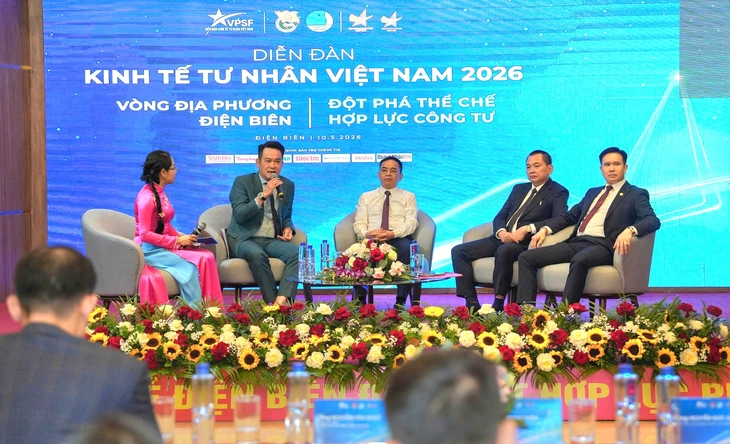 Businesses share the bottlenecks that need to be addressed.
This is the first dialogue session of VPSF 2026 in the Northern mountainous region. The program is hosted by the Dien Bien Province Young Entrepreneurs Association.
A special mechanism is needed to unlock resources.
Mr. Dang Hong Anh - Vice President of the Vietnam Youth Union, President of the Vietnam Young Entrepreneurs Association, and President of the Vietnam Private Sector Economic Forum 2026 - affirmed that the private sector is not only an important driving force but must also be a pioneering force in innovation and technology mastery.
To realize the goal of double-digit growth, VPSF 2026 will not only focus on highlighting difficulties but will also be a platform for working with the Government and local authorities to "co-create" solutions.
Regarding Dien Bien province, which has all the conditions to become a new growth pole in the Northwest region, Mr. Hong Anh suggested that the province needs specific mechanisms, prioritizing the unlocking of land and credit resources to support businesses in participating more deeply in the high-tech agricultural value chain and the digital economy.
Accordingly, the Vietnam Young Entrepreneurs Association committed to acting as a bridge, directly synthesizing and proposing breakthrough institutional solutions from Dien Bien's practical experience to central ministries and agencies to create the most transparent and favorable business environment for enterprises.
Mr. Nguyen Van Doat - Vice Chairman of the Provincial People's Committee - affirmed that Dien Bien is undergoing a strong transformation with the aspiration to become a new growth pole in the Northwest region, using the private sector as a strategic driving force for rapid and sustainable development.
The province has identified three pillars of development: high-tech green agriculture, historical-ecological-resort tourism, and renewable energy linked to strategic infrastructure. At the same time, the province is committed to continuing to genuinely support businesses, reforming administrative procedures, and proactively resolving difficulties and obstacles for businesses in the spirit of "faster, more substantive, and more effective."
He added that Dien Bien province hopes the business community will continue to show interest, cooperate, and invest long-term in Dien Bien; working together with the province to effectively exploit its unique potential, turning difficulties into opportunities, and transforming aspirations into driving forces for development.
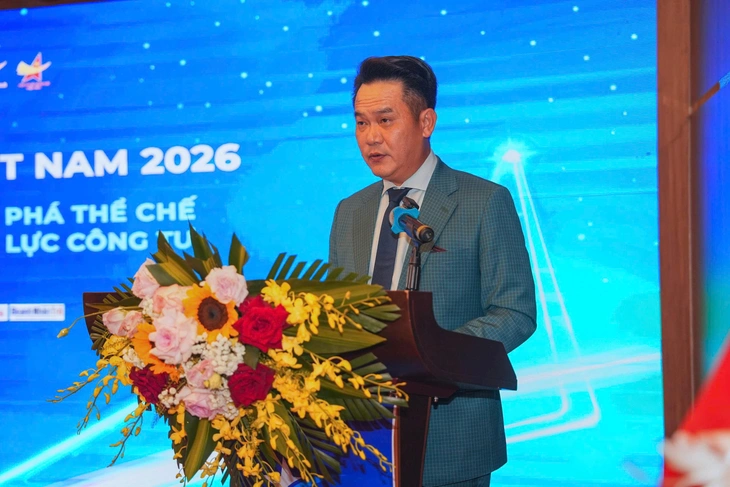 Mr. Dang Hong Anh speaks at the dialogue session.
Removing Bottlenecks in the Investment and Business Environment
From a business perspective, Ms. Nguyen Thi Linh, Director of Huong Linh Co., Ltd., said that Resolution 68 has unlocked private economic resources, but to shorten the gap between policy and reality, it is necessary to remove bottlenecks that are hindering development.
First and foremost are transportation infrastructure and the burden of logistics costs; transportation costs account for too large a proportion of the cost, reducing the competitiveness of local products. Addressing issues related to credit and land resources, including public land, is also crucial.
"Startup businesses are caught in a vicious cycle: to borrow capital, they must have revenue and collateral. If they don't have enough initial investment capital, they can't generate revenue or produce quality products. Therefore, we hope for a legal framework that allows us to borrow on a credit basis based on the feasibility of the project," Ms. Linh said.
Another issue is facilitating businesses' access to surplus public land after mergers to establish production and business facilities. This is linked to promoting innovation and digital transformation, unlocking human resources, and implementing specific mechanisms.
Based on the practical experience of Dien Bien, businesses proposed initiatives, most notably the "Three-Front Battle" strategy, inheriting the spirit of Dien Bien Phu to create breakthroughs in three key areas: economy, technology, and market.
This emphasizes expanding business scale, mastering AI and IoT technologies, and promoting e-commerce and exports. It also promotes digital transformation in agriculture through digital value chain management models for coffee and macadamia nuts, aiming for 100% digitization of growing areas...
According to Tuoi Tre Newspaper