As requirements for green development, resource efficiency, and stable operations increasingly become key criteria, the value of industrial parks and industrial clusters lies in more than just their land assets.
Recently, at the Vietnam Industrial Real Estate Forum (VIPF) 2026, Thanh Thanh Cong Industrial Zone JSC (TTC IZ, a member of TTC Group) shared strategies for managing operational risks to enhance long-term value for investors.
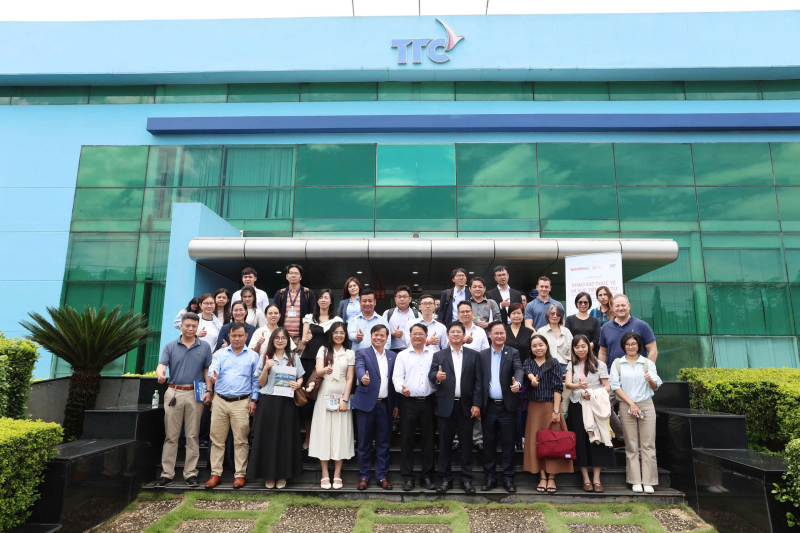 TTC IZ shared its strategic direction for developing a smart eco-industrial park model with the visiting delegates.
When operational capability becomes part of investment value
For manufacturing enterprises, an investment decision regarding an industrial park spans decades. Throughout that lifecycle, factors such as wastewater treatment, power supply, technical infrastructure, logistics, human resources, and the ability to meet environmental standards can directly impact production continuity and operating costs.
Consequently, the value of an industrial park is derived from its ability to establish a stable foundation that allows enterprises to maintain operations, control costs, and adapt to increasingly rigorous market demands. Mr. Nguyen Thanh Chuong, General Director of TTC IZ, states: "Do not look solely at land lease rates; consider operational capability. When risks are identified and managed at the industrial park infrastructure level, enterprises can focus their resources on core activities and be more proactive in meeting rising market expectations."
TTC IZ manages risk at the infrastructure level
Practical experience at the Thanh Thanh Cong Industrial Park in Tay Ninh clearly demonstrates this approach. TTC IZ manages a 215-hectare centralized textile and dyeing zone accounting for approximately 41% of the park's leasable land a manufacturing sector with stringent environmental control requirements, particularly regarding wastewater.
TTC IZ has invested in two wastewater treatment plants with a combined capacity of 27,000 m³/day, establishing centralized treatment capabilities for the entire zone.
For investors, the system's value lies not only in its treatment capacity but also in its ability to bring risks that could directly affect production operations under a control mechanism right at the industrial park level. This reflects a shift in the perspective on industrial parks: as demands regarding ESG, environmental standards, and supply chain responsibility intensify, infrastructure quality is no longer merely a supporting factor but has become integral to the competitiveness of tenant enterprises.
Wastewater treatment plant for the textile and dyeing zone at Thanh Thanh Cong Industrial Park, Trang Bang, Tay Ninh.
Leading Green Industrial Real Estate Developer 2026
For TTC IZ, the green transition is directly linked to operational efficiency and long-term business growth. Consequently, solutions regarding wastewater treatment, renewable energy, resource management, and technical infrastructure are approached as components of an integrated operational system.
This strategic direction was further recognized at the VIPF 2026 Forum, where TTC IZ was honored as one of the top five enterprises in the "Leading Green Industrial Real Estate Developer 2026" category at the "Green Future Awards 2026" ceremony marking the third consecutive time the company has received recognition in this program.
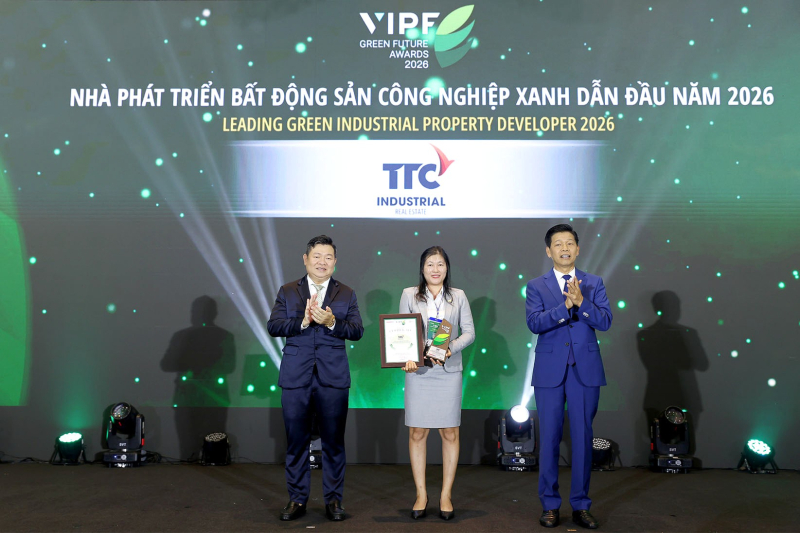 Ms. Dinh Thi Ngoc Trang, Deputy General Director of TTC IZ, accepted the award on behalf of the company.
Discussing the challenges of transforming industrial parks into eco-industrial parks drawing on practical experience from the Thanh Thanh Cong Industrial Park and addressing general market demands Mới. Dinh Thi Ngoc Trang, Deputy General Director of TTC IZ, identified the greatest challenge: restructuring infrastructure that simultaneously serves hundreds of enterprises. For TTC IZ, this entails shifting from isolated "end-of-pipe" treatment methods to a shared circular system featuring water reuse, clean energy, and transparent resource data connectivity among businesses.
"We are currently conducting surveys to develop shared infrastructure such as biomass steam networks and water circulation systems to connect individual enterprises into a genuine industrial ecosystem," she added.
Scaling up on a foundation of sustainable development
For the 2026–2030 period, TTC IZ aims to develop 2,700 hectares of industrial land and 1 million square meters of warehouse space, with a mandate for comprehensive upgrades to green infrastructure, digital infrastructure, and clean energy systems.
In Tay Ninh, the Tan Hoi 3 and 4 Industrial Clusters are being developed to create a new industrial zone in the province's north, aiming to attract capital flows that demand high-quality infrastructure and rigorous development standards.
The Da Oai Industrial Cluster (Lam Dong) serves as a strategic link connecting Southern economic hubs with the Central Highlands, further strengthening TTC IZ’s industrial development network.
Alongside expanding its operational footprint, TTC IZ aims to create stable employment for over 45,000 workers, thereby enhancing socio-economic impact in the localities where its projects are situated. Building on that foundation, TTC IZ aims for long-term growth, where scaling up goes hand-in-hand with elevating infrastructure standards, operational capabilities, and the ability to create sustainable value for investors.
Source: Vietnam Young Entrepreneurs Newspaper