Besides pillars such as public investment and exports, domestic consumption needs corresponding support policies to pursue ambitious growth targets, according to experts.
Public investment is the mainstay, consumption will "reinforce"
Current growth support policies only focus on “supply stimulation” instead of “demand stimulation”, Mr. Dang Van Thanh, Chairman of the Board of Directors of TTC Group, shared at the Vietnam Investment Forum (VIF) 2026 held on the morning of November 4.
Mr. Thanh proposed that there should be policies to support private consumption. For example, reducing personal income tax, or stimulating consumption through a subsidy policy with discount vouchers instead of cash, with a time limit for consumption. This policy aims to help increase the “circulation” of cash flow in the economy.
Talking about expectations for 2026, Mr. Thanh said that GDP growth could reach 8-10%, in which public investment will be the mainstay, the private economic sector will be consolidated, and domestic consumption will be a factor to “reinforce” growth.
“2026 is about to enter a new race, no expert has predicted the price of gold or the dollar, but the common point is that there will be a new starting point. Public investment will be the driving force, and consumption will help strengthen the economy. With a market of 100 million people, Vietnam can create better initiative instead of dependence, in which export or FDI, which is a big challenge for entrepreneurs,” Mr. Thanh said.
 Chairman of TTC Group, Mr. Dang Van Thanh shared at VIF 2026.
Currently, the economy's demand is assessed to be growing below potential. Ms. Vu Ngoc Linh, Director of Market Analysis and Research, VinaCapital Fund Management Company, said that domestic consumption is still relatively weak if excluding two factors: international tourism. Accordingly, retail growth is only at 5-6% after excluding inflation, significantly lower than the period before the Covid-19 pandemic.
However, this will also bring growth opportunities for 2026 when demand recovers. According to Ms. Linh, there are three factors that expect domestic demand to increase. One comes from the effect of increasing assets, people's disposable income increases when the government stimulates demand this year. The remaining issue is that retail companies will take advantage of market conditions and scale advantages to expand revenue.
Growth and Risks
The Government's 2026 growth target is in the double digits, with a heavy emphasis on the 10% figure. Considered very ambitious, but in general, most experts are optimistic about future growth trends.
Without commenting on the growth figure, Mr. Le Duy Binh, Director of Economica Vietnam, said that the growth rate in 2026 will be higher than this year.
Up to now, Vietnam's economy has overcome many difficult periods, and its endogenous capacity has also increased based on stable macroeconomic and political conditions and the confidence of domestic consumers as well as foreign investors in Vietnamese manufacturers. "These are important foundations for us to believe in better growth prospects in 2026 and the following years," Mr. Binh said.
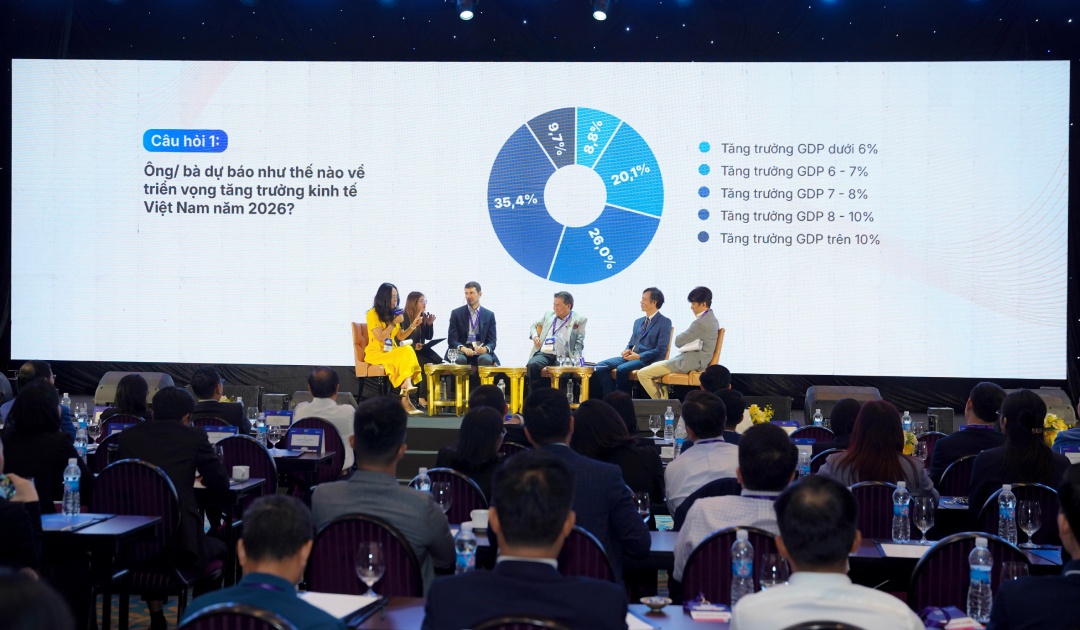 Speakers shared their views on the potential for economic growth in 2026 at the Vietnam Investment Forum 2026, jointly organized by VietnamBiz and Vietnam Moi, which took place on November 4. Photo: DNCC
Mr. Sacha Dray, economist, World Bank Vietnam, assessed that the context at the beginning of the year is “very different” from now, in a complicated global macro situation, with geopolitical tensions. However, Vietnam “is making very positive progress and the transformation is also very strong”.
“Vietnam’s current support policies have helped to reduce the “level of anxiety” in the economy to some extent”, Mr. Sacha commented.
Although trade relations can be normalized and exports recover well, the representative of World Bank Vietnam also noted that trade risks are still “hanging” in goods identified as “transit”, which can affect about 17% of the revenue of goods, according to World Bank calculations.
The representative of Economica Vietnam said that it is necessary to pay attention to the crowding out effect of private investment when focusing too much on public investment; or high growth rate also depends on how to respond to risks related to monetary policy, inflation and public debt, because the growth model also depends heavily on capital and credit. “These are issues we need to calculate carefully,” Mr. Binh emphasized.
According to Saigon Economic Newspaper