Resolution 68 is a recognition, encouragement, and promotion of the private economy to develop. When recognized, entrepreneurs must do it, as a mission.
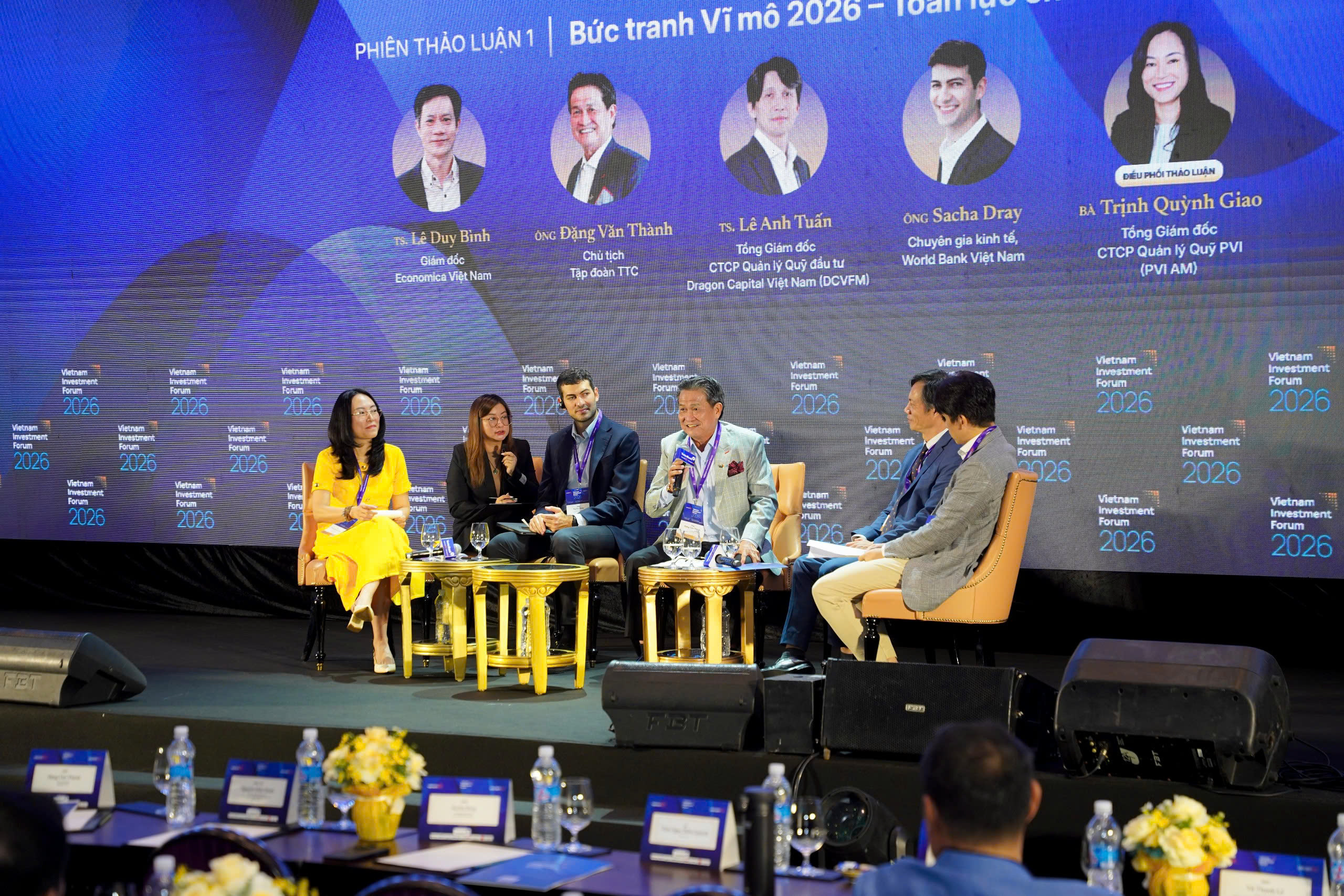 Mr. Dang Van Thanh shared at the forum. Photo: Organizing Committee
The country is entering a new era, Resolution 68 - NQ-TW was born with the spirit of promoting the development of the private economy, then Resolution 198/2025/QH15 was born with the nature of a law to institutionalize Resolution 68.
This has created great excitement for the private enterprise sector. At the Vietnam Investment Forum 2026, Mr. Dang Van Thanh, Chairman of TTC Group, also said that the Vietnamese business community is very excited about the new direction. Policies not only need to be issued promptly but also must be compatible, requiring urgency. 2026 is the year of foundation for the period 2026 - 2030.
“The State will create the environment, and we must be aware to integrate into the world economy. This is extremely difficult. People often say that this is the digital age, the 4.0 era, the knowledge economy, so what should we do? That question is no longer a question, but the entrepreneurs themselves must face it,” Mr. Thanh shared.
The entrepreneur sees the current period as the period when Vietnam opened up, preparing to enter the WTO. Today, Resolution 68 is a recognition, encouragement, and encouragement for the development of the private economy. When recognized, entrepreneurs must do it, as a mission.
Mr. Thanh expressed that the economy has just experienced many shocks after the Covid pandemic, difficulties on top of difficulties. The government has had many policies, but mainly to stimulate supply such as reducing VAT, reducing interest rates, extending debt... However, the problem is how to stimulate demand?
In 2026, the Chairman of TTC Group believes that public investment will continue to play a driving role, but only temporarily - a temporary driving force, everything must return to the true nature of an economy. Finally, entrepreneurs must fulfill the mission of implementing bilateral and multilateral agreements - not only for the country but also for their own units.
From his perspective, Mr. Thanh believes that 2026 is the time to prepare to enter a new race for the 50-year cycle. If we look back 10-15 years ago, change followed the rules and progress, in which the law of elimination was the law of development. If a business does not comply, it will be eliminated.
“The core of the market is management, control and operation. Young entrepreneurs today, I hope you stick to this to be more confident. When it comes to sustainable development, we must, together with the Government, the staff, employees and investors, be responsible to investors, to capital for development, and gradually have enough conditions to inherit FDI. Attracting FDI is inevitable, every country needs it. However, attracting FDI capital is not only money but also technology, at some point, Vietnamese enterprises will have the conditions to inherit. That is one of the missions of entrepreneurs that Resolution 68 expects, implemented by Resolution 198 of the Government”, Mr. Thanh expressed.
Public investment should be like seed capital
Mr. Le Duy Binh, Director of Economica Vietnam commented that besides the driving force of export and public investment, investment in the business sector, especially private investment and FDI will be the driving force for economic growth.
With the issuance of Resolution 68, the private sector has shown new enthusiasm. Many key projects with the participation of private enterprises are being implemented, while many projects with legal problems are also being resolved. The increase in the number of newly registered enterprises and those returning to operation in the first 9 months of the year is a very positive signal that private investment is recovering strongly.
After each crisis, after each difficult period of the economy, according to the common law of economics, public investment always plays a very important role in promoting the economy's aggregate demand.
Vietnam is in the process of transitioning to a new growth model, so the need for infrastructure and the expansion of economic space is extremely necessary. Therefore, public investment is still expected to be an important driving force of the economy. However, according to Mr. Binh, in the long term, public investment capital should not be pushed too strongly, because that has some potential risks.
First, too much public investment can create a "crowding out" effect on private investment, which means reducing the investment motivation of the private sector. Second, when public investment increases, the State is forced to increase budget revenue or borrow more. And increased budget revenue means that the tax burden and other financial obligations also increase, creating pressure on the private economic sector. Every business and every taxpayer can feel this pressure to some extent.
Therefore, public investment will continue to play an important role, but in the future, it is expected that private investment will gradually replace and take on a stronger role, especially in infrastructure projects that the private sector can participate in.
Mr. Binh believes that public investment should only focus on projects that are not attractive or not attractive enough for the private sector. At the same time, public investment needs to act as “seed capital”, together with the private sector, investing in large infrastructure projects, in the form of PPP or other cooperation models.
Thus, the role of public investment in the future will be a catalyst, creating motivation and promoting private investment more strongly. Thus, public investment is an important driving force, but it needs to be more effective, focusing on projects that can create a change in the situation and open up new growth spaces that have not been exploited before.
According to Nha Dau tu Newspaper